
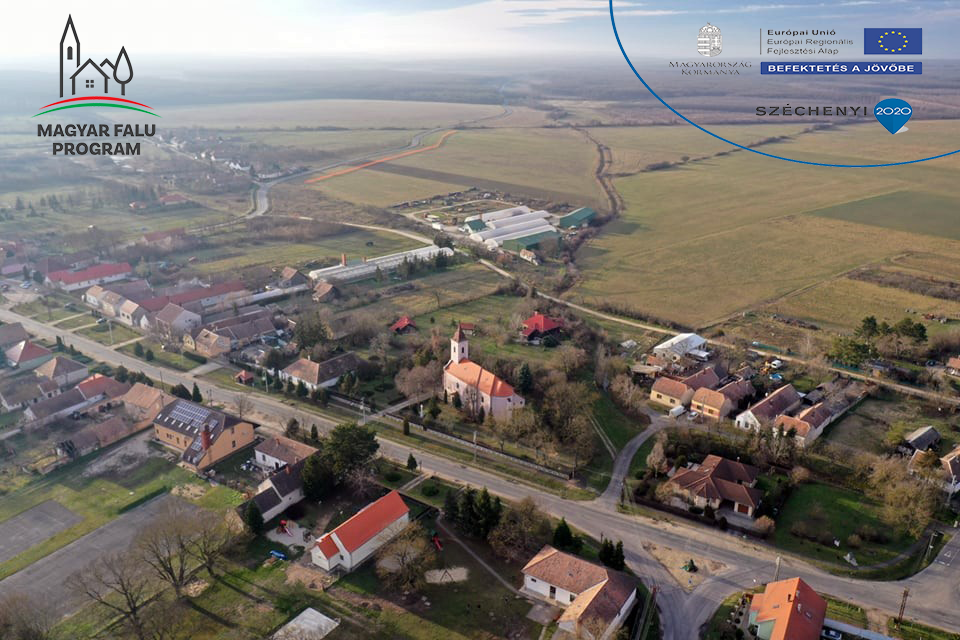
Stop point - Csapod
The St Martin's Road is on the outskirts of the municipality.
The name of the settlement first appears in a document from 1257 as Chapud: the present-day villages of Csapod, Hövej and Pusztacsalád do not yet have their own names, so they are referred to as "three families". In 1284, it was listed as one of the 'keeth Chalad', in 1309 as Chapudchalad, and in 1325 in the Osl clan's division as a separate municipality, now called Chapud. It became the property of the Osl family, then around 1380 of the Kanizsa family, and later, together with the Kapuvár manor, as a part of it, it became the property of Tamás Nádasdy in 1536 and of Pál Esterházy in 1681. In 1594 the Turks destroyed the Rábaköz and with it the settlement, the population died out or fled. In the 17th century, Croats and Italians were settled in the village.
The 17th century status of Csapod was described in the 1660 urbárium, when the village consisted of two rows of houses. The parish house stood on the lower floor. The serfs had 16 acres of ploughland, there was no mowing field, but they could mow in the forest. For their arable land they paid a rent of 20 denarii per acre and a rent of 20 denarii per acre. The place of the clearings was the Wolf's Den, with an area of 70 acres. In the 18th century, the Esterházy family organised the landlord's manor. In 1766, there were already 3 manors in the village. Some of the people of Hapod worked in the major of Szentmiklós, others in the major of Kapuvár. The national events of the end of the 17th century, the wars of liberation, the migrating or conscripted troops, and the events of the Rákóczi War of Independence halted the development of the village.
Further information and source: http://www.csapod.hu/index.php/kozsegun-csapod
Accommodation in Csapod:
Csalogány Tábor - Csapod Vasút u. 6. Tel.: 70 313 75 42 (József Horváth) E-mail: csalogany64@t-online.hu
Hasonló találatok
Stop point - Rábapordány
RábapordánySt Andrew's Church was built in 1867 and extended in 1912. The ceiling paintings were made by József Samodai.
More
Stop point - Himod
HimodThe first known document mentioning Himod dates back to 1408. In the Middle Ages Himod and the other settlements in the area...
More
Stop point - Gencsapáti
GencsapátiThe St. Martin's Way passes through the outskirts of the village, the vineyard and the Szentkút. The tradition of the St....
More
Stop point - Egyházasfalu
EgyházasfaluThe St. Martin's Road runs along the northern edge of the village. The present village was formed by the merger of the villages...
More