Stop point - Ásványráró - alvary on the banks of the Danube
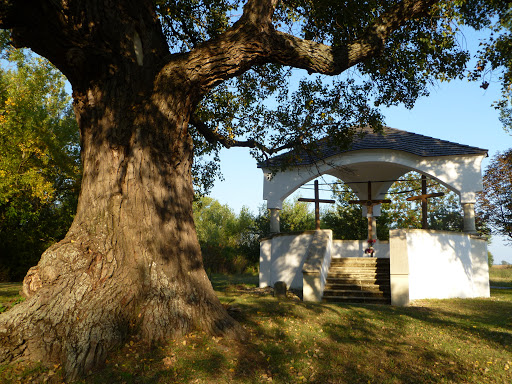
It is the earliest triangular building in Hungary. It was built by Lázár Apponyi, landlord of Ráró, in 1738.
Its designer is not known, but the design of the columns suggests that it was the work of the Carmelite monk and architect Márton Athanáz Wittwer.
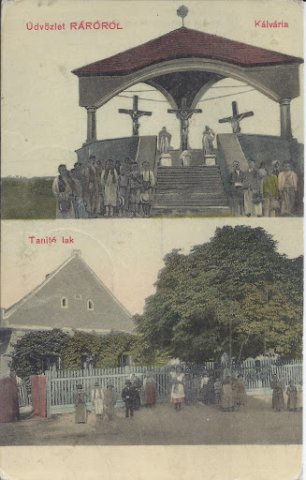
The church visitation record of 1754 mentions that the calvary contains statues of the Virgin Mary and, under the cross, of St John the Evangelist. Renovated again in 1844, the statues of the saints at the steps are mentioned. In photographs taken before the First World War, angel heads with wings above the columns adorn the façade. A postcard from 1925 shows the Calvary with its statues. It was badly damaged by a Soviet mortar attack during the Second World War on 1 April 1945, presumably when the statues were destroyed. The last time the Calvary was restored was in 2006, with the help of a broad social coalition. On Sunday, 24 September 2006, the renewed building was blessed in a Mass of thanksgiving by the Carmelite Father László Zdiarszki. Today, the condition of the Calvary would require another renovation.
Everything is tripled in the Calvary. On the oval parapet stand three slender, cube-shaped columns. These hold up the three-sided vault. Underneath are three crosses, the two outermost of which face towards the centre. The Baroque monument depicts Jesus and the two crosses of the Lator crucified with him.
Coming from Győr, the Calvary is on the right-hand side of the town boundary and is open to the public at all times.
Hasonló találatok
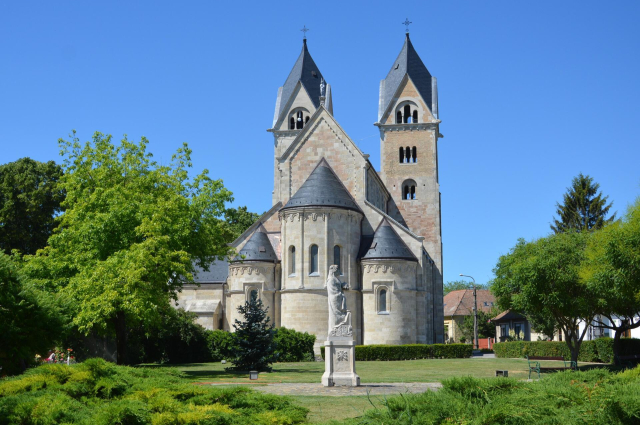
Stop point - Lébény - St James Church
Lébény - Szent Jakab templomThe Benedictine monks settled in Lébény in the Árpád era. The abbey is already mentioned in a document dated 1199. The church at...
More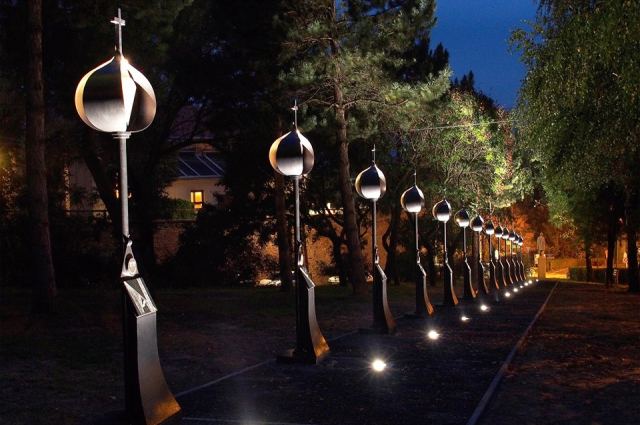
Stop point - Pannonhalma - Everyone's Crossroads
Pannonhalma - Mindenki keresztútjaThe Way of the Cross, inaugurated in autumn 2014, is located in the park next to the parish church, behind the statue of St...
More
Stop point - Pannonhalma Archabbey
Pannonhalma -FőapátságFounded in 996 and still, in continuous operation, the Benedictine monastery of Pannonhalma is one of Hungary's most outstanding...
More
Stop point - Fertőrákos - Sanctuary of Mithras
Fertőrákos - Mithras SzentélyThe Mithraic Sanctuary[1] or Mithraic Cave[2] (Latin: Mithraeum) is a Roman monument in Győr-Moson-Sopron County, a former...
More